The Role of Variance Calculations in Determining Progressive Jackpot Eligibility on Multi-Game Platforms
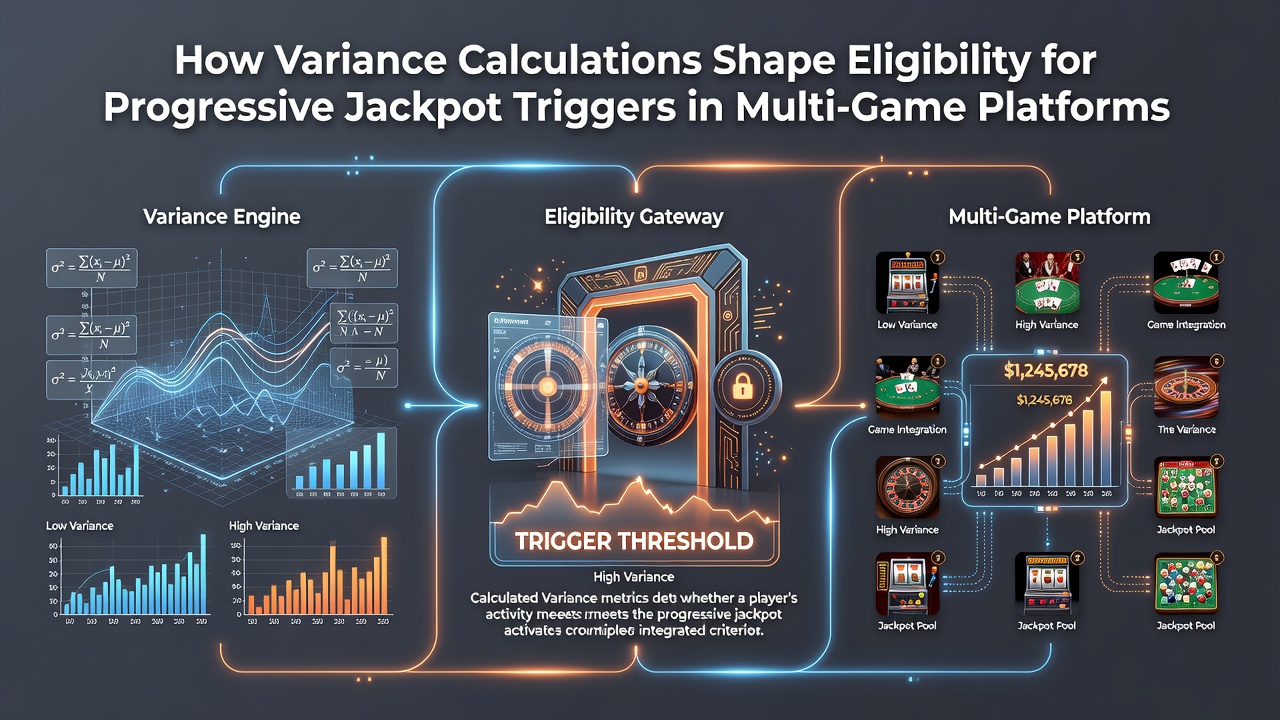
Progressive jackpots operate through pooled contributions from multiple titles on shared platforms, and variance calculations determine which games qualify for participation in those pools as well as how trigger probabilities distribute across them. Platforms aggregate wagers from slots, table games, and video poker variants, yet each title carries its own volatility profile measured through standard deviation of return-to-player outcomes. Operators apply these metrics to maintain pool stability, since high-variance games contribute larger but less frequent amounts while low-variance titles supply steadier increments that affect overall trigger frequency.
Defining Variance Within Multi-Game Environments
Variance quantifies the spread between expected and actual payout sequences over defined sample sizes, and multi-game platforms rely on this measure when setting contribution percentages that feed into shared jackpots. Research from the University of Nevada's gaming laboratory indicates that titles exceeding a volatility index of 12.4 typically receive reduced allocation rates to prevent rapid pool depletion, whereas those below 6.8 gain higher percentages that accelerate accumulation without destabilizing trigger intervals. Data compiled through July 2026 across North American networks shows average contribution weighting of 1.8 percent for medium-variance games versus 0.9 percent for high-variance counterparts, a pattern that equalizes eligibility windows across diverse catalogs.
Regulatory Frameworks Guiding Calculation Standards
The Nevada Gaming Control Board and the Malta Gaming Authority both mandate documented variance modeling before any title joins a progressive network, requiring operators to submit simulation data covering at least 10 million spins or equivalent hands. These submissions establish baseline trigger odds that must remain within five percent of projected intervals after variance adjustments. Canadian provincial regulators in Ontario have adopted similar protocols since 2024, mandating quarterly audits that recalibrate contribution rates when observed standard deviations deviate more than three percent from initial filings. Such requirements ensure that eligibility does not favor any single volatility category and that pooled funds remain sustainable across platforms operating in multiple jurisdictions.
Mechanics Linking Variance to Trigger Eligibility
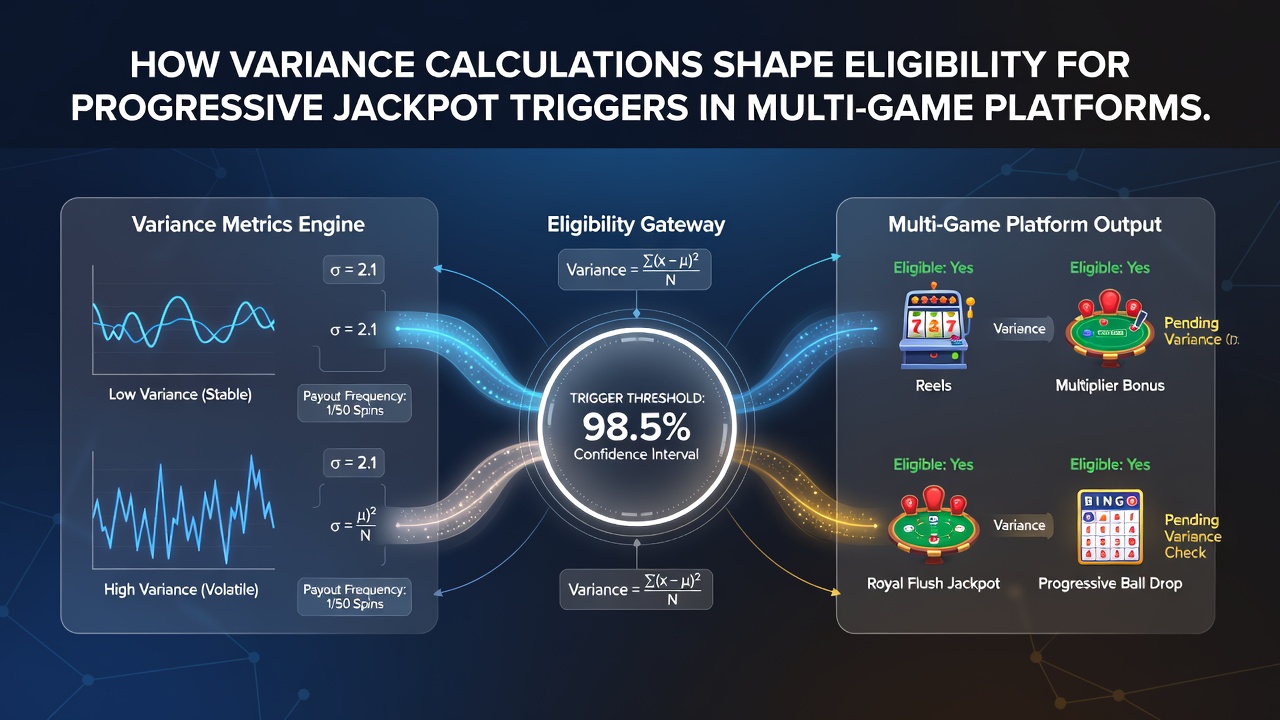
Eligibility thresholds incorporate variance-adjusted random number generator seeds so that jackpot triggers align with each game's mathematical profile rather than uniform probability tables. A medium-variance slot might trigger at 1 in 12 million spins after weighting, while a high-variance counterpart on the same platform triggers at 1 in 18 million spins because its larger standard deviation requires wider intervals to balance contribution volume. Platforms run Monte Carlo simulations nightly to confirm these ratios hold within acceptable error margins, and any title falling outside the modeled band loses temporary access until operators adjust its contribution coefficient. This process prevents low-variance games from monopolizing triggers and high-variance titles from starving the pool of consistent funding.
Platform Implementation Across Global Markets
Australian operators licensed under the Northern Territory Racing Commission apply variance banding that segments games into five tiers, each with distinct eligibility windows published in quarterly transparency reports. European platforms following directives from the Gibraltar Regulatory Authority integrate variance scores directly into their central jackpot controllers, automatically suspending participation for any title whose live volatility exceeds modeled parameters by more than four percent. Industry reports from the European Gaming and Betting Association document that these automated safeguards reduced jackpot disputes by 23 percent between 2024 and 2026 while maintaining average payout intervals within 2.1 percent of published odds.
Data Patterns Observed Through Mid-2026
Figures released by the New Jersey Division of Gaming Enforcement in July 2026 reveal that multi-game progressive systems incorporating variance-based eligibility processed 47 million qualifying wagers monthly, with high-variance titles accounting for 31 percent of contributions yet only 19 percent of triggers. Medium-variance games, by contrast, generated 48 percent of triggers despite representing 42 percent of total pool funding. These distributions demonstrate how variance calculations actively reshape participation rates rather than merely describing them, producing more predictable payout schedules across entire platform catalogs.
Conclusion
Variance calculations serve as the quantitative foundation that determines which games gain access to progressive jackpot pools and at what contribution levels they operate within multi-game environments. Regulatory bodies across multiple continents enforce standardized modeling requirements that translate statistical volatility into operational parameters, ensuring trigger mechanisms remain balanced regardless of individual title profiles. Continued refinement of these methods through simulation and live-data auditing supports sustainable jackpot growth while preserving fairness across diverse gaming libraries.